Samples of questions you may want to ask your Trx-Buddy
Below is a selection of examples/suggestions for questions you can ask orally or in writing to Trx-Buddy – your advisor and assistant, limited to data and information we collect on behalf of your business in addition to general external factors that may affect your business's operations, budgets and results.
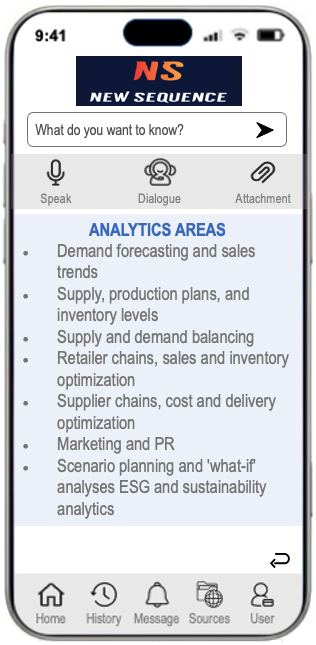
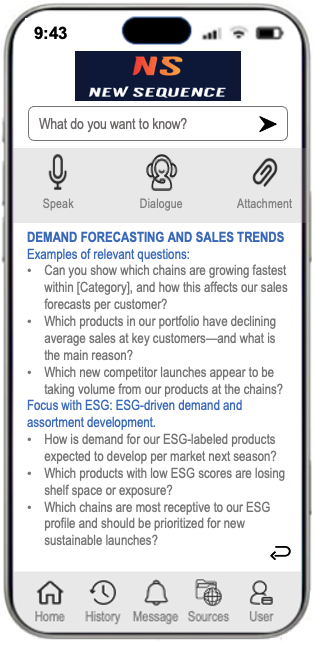
1. Demand forecasting and sales trends
Suppliers want to understand how demand develops per retailer and category – and where to prioritise assortment and launches.
- Can you show which retail chains/customers are growing fastest within [Category], and how this affects our sales forecasts per customer?
- Which products in our portfolio are seeing declining sell-out at key customers, and what are the main drivers (price, competitors, ESG score)?
- Which new launches from our competitors appear to be stealing demand from our products at the retailers?
- How do you expect demand for our organic/ESG-labelled products to develop per market next season?
- Which of our low ESG-score products are starting to lose shelf space or receive weaker in-store exposure?
- Can you identify which retail chains are most receptive to our ESG profile, and where we should prioritise launching new sustainable products?
- Which customer segments within the retailers respond most positively to our ESG messages (e.g. younger, urban, outdoor-focused customers)?
- Which markets/chains are seeing the strongest growth in demand for products with a high social score (e.g. fair trade, living wages)
ESG focus – product and assortment development
- Which of our high ESG-score products have untapped sales potential with existing retailers, based on similar launches?”
- Which customer requirements/ESG trends at retailer level should we feed into the next product development cycle (material choices, traceability, repairability)?”
2. Supply, production planning and inventory
Questions from sales planning, production and logistics – to avoid both stock-outs and overproduction.
- Can you show current inventory levels per SKU and per major customer, and where we face high risk of backorders or stockouts over the next 4 weeks?
- Where do we have overproduction or excess inventory at plant/central warehouse level, and which retail chains can realistically absorb this volume through campaigns?
- When should we reduce the production rate for [SKU/Category], based on the actual sales velocity in stores?
- Which products have high return/complaint rates from retailers, and how does that affect both cost and our ESG footprint?
- Can you give us a Weeks of Supply (WOS) view per customer for key SKUs, and propose production adjustments?
ESG focus – ESG-adjusted production and inventory
- Which products with a high climate impact per unit should we reduce production of, given current demand and ESG requirements from retail chains?
- Where do we have overstock of ESG-strong products, and how can we use this strategically in negotiations with retailers (campaigns, exposure)?
- What is the environmental and waste cost if we have to destroy or heavily discount overproduction of [SKU]?
- Which plants/production lines have the weakest ESG profile, and which products from these are most exposed to future retailer requirements?
- Where can we achieve the largest ESG gains by shifting volume from one factory/supplier to another, without creating delivery risk?
3. Balancing supply and demand
Used when manufacturers must choose between customers and SKUs – and minimise lost sales.
- Which products have a systematic mismatch between our production plan and actual demand at retailer level, and how much turnover are we and the retailers losing?
- Which chains have the highest risk of running out of our bestsellers, and should be prioritised in allocation when supply is tight?
- Should we reduce production or reallocate volume on slow-moving SKUs, or rather invest in marketing support with key customers?
- Which products should we phase out earlier because demand is falling faster than planned?
- Which retailer campaigns have historically helped us to profitably rebalance over- and undersupply?
ESG focus – ESG in imbalance detection
- How much value is lost due to imbalances in our most sustainable products (too little volume on shelf relative to demand)?
- Which high ESG-risk products are being pushed into clearance campaigns to empty inventory, and what regulatory/reputational risks does this create?
- Can you compare the ESG scores of products we overproduce with those where we have under-supply at the retailers?
- Should we reprioritise production from high-risk value chains to low-risk ones to reduce both ESG risk and future inventory write-downs?
- Which customers (chains/markets) are most willing to take additional volume of ESG-positive products to help us balance the portfolio?
4. Supplier network and cost optimisation (upstream focus)
From sourcing, supply chain and finance – to control input cost, risk and service levels towards retailers.
- Which of our upstream suppliers (materials/components) drive the most cost volatility in our cost of goods sold, and how does this link to demand patterns at the retailers?
- What is the break-even point for increasing safety stock of critical input materials to secure deliveries to key customers next season?
- What does it cost us to hold too much finished-goods inventory when a retailer reduces orders by [xx]%?
- Which suppliers/plants create the highest risk of delayed deliveries and penalties/fines from retailers?
- Can you simulate the impact on margins if we shift volume to a slightly more expensive but more reliable supplier with a better ESG score?
ESG focus – ESG in supplier and cost assessment
- What is the total ESG cost (climate, social risk, compliance) of continuing to use a low-cost supplier with a weak ESG score versus switching?
- How does the choice of raw material supplier affect our CSRD reporting and the retailers’ own ESG requirements?
- Where can we reduce total cost in the long term through ESG collaboration with retailers (e.g. joint projects on traceability, returns and repair)?
- Which components/raw materials offer the greatest potential to cut emissions per unit without weakening commercial terms towards retailers?
- Where is the risk highest for non-compliance costs in our supply chain (e.g. human rights, due diligence), seen in light of our largest customers?
5. Supplier network and cost optimisation (upstream focus)
Management and key accounts want to see how the manufacturer handles demand shocks, growth and new requirements.
- What happens to our ability to supply key customers if demand increases by 20% next season in [Category], given current capacity and lead times?
- What if a key raw material supplier is out for 3 months – which products and retail chains are hit hardest, and what alternatives do we have?
- How would a sharp currency movement or increase in freight costs impact profitability per customer and product line?
- What-if scenario: A major retail chain requires a 30% reduction in CO₂ per product within two years – which product lines and factories must we change first?
- How do different price increase scenarios (e.g. +5%, +10%) affect both volume and the relationship with our top 5 customers?
ESG focus – simulating ESG and regulatory scenarios
- What if CSRD and new due diligence requirements mean that retailers will only list products with documented low ESG risk – how many of our SKUs would then drop out of the assortment?
- How would stricter climate rules, such as carbon border taxes or lower-emission transport requirements, affect our margins and delivery strategy?
- What if we launch a dedicated ESG product line at a higher price point – which chains and markets are most likely to adopt it quickly?
- How would different weather scenarios (mild winter, extreme summer) impact both demand and ESG footprint for our key product categories?
- What happens if a major retailer sets a minimum threshold for social score (working conditions, living wages) – which factories and product ranges must we overhaul?